
You spend forty minutes waving your hair. It looks incredible. You leave the house, and by the time you get where you are going it has quietly relaxed back into the same straight hair you started with.
If this is your life, you have probably concluded that your hair “just doesn’t hold curl.” It is a fair conclusion and it is nearly right — but the fix is not a better curling iron or a hotter setting. It is understanding why fine straight hair resists a wave, and then working around it rather than fighting it.
Why Fine Straight Hair Drops Curl
It is smooth, and smooth means slippery. A curl holds partly because strands catch on each other. Fine straight hair has a flat, even cuticle with very little friction, so the strands slide apart instead of staying grouped.
Individual strands are small and light. There is less mass to hold a shape once it has been set.
The weight of the hair pulls downward. Even fine hair, in any real length, exerts a steady gravitational pull on a curl that is not firmly set.
Clean hair is the worst possible starting point. Freshly washed, conditioned hair is at its smoothest and most slippery.
And people compensate with heat, which makes it worse. More heat does not equal more hold. What it does is damage fine hair, and damaged fine hair holds curl even less well while looking limp and see-through. This is the trap most people fall into.
The actual levers are texture, cooling and hold — none of which have anything to do with turning the dial higher.

Start With Texture, Not Heat
This is the step that changes everything, and it happens before any tool touches your hair.
Style on second-day hair. Genuinely the easiest improvement available. Hair with a day’s natural oil has more grip and holds a wave dramatically better than freshly washed hair. If you must wash, at least skip conditioner on the mid-lengths and roots.
Use a texturizing or sea salt spray on dry hair before curling. These work by roughening the surface of the strand very slightly and adding a light residue, both of which create friction. That friction is what stops the wave sliding out. Spray through the mid-lengths and ends, scrunch a little, and let it settle before you start.
Add a light mousse at the roots for lift, since flat roots make waves look like they are dropping even when they are not.
Skip anything heavy. Rich conditioners, leave-in creams, oils and serums on the lengths are all working against you. Fine hair goes limp under weight faster than any other type.
If you are looking for products, holding sprays for fine hair are formulated to add grip without the stiffness or weight that flattens fine strands.
Choosing and Setting Up Your Tool
A three-barrel waver is the most reliable route to a beachy S-wave and the fastest. It clamps a section into a fixed shape, which suits hair that will not hold a wrapped curl.
A curling wand, around 25 to 32 millimetres, gives a looser, more natural result.
A flat iron, used with a twisting motion, works well and is often already in your bathroom.
Whichever you use:
Keep the temperature moderate. Fine hair heats through almost instantly, and the low-to-middle end of your tool’s range is genuinely enough. High heat damages fine hair fast, and once it is damaged, hold gets worse rather than better.
Always use a heat protectant, applied as a light mist rather than a cream.
Work on completely dry hair.
The Technique
Take medium sections. Too thin and you get tight ringlets that look nothing like beachy; too thick and the heat will not penetrate and the wave will drop. Roughly five centimetres wide is a reasonable starting point.
Alternate the direction. Curl one section toward your face, the next away from it. Uniform direction reads as a set hairstyle rather than natural texture.
Leave the ends out. Do not wrap the last few centimetres around the barrel. Straight, slightly loose ends are the defining feature of a beachy wave — fully curled ends look like a completely different, more formal style.
Start below the root. Begin the wave a few centimetres down rather than right at the scalp. This gives a more undone look and keeps the iron away from your skin, which matters especially on shorter cuts where there is very little hair between the barrel and your scalp.
Hold briefly. A few seconds is plenty for fine hair. Longer does not improve hold; it just cooks the strand.
Do not curl every section. Leaving a few sections straight, particularly underneath, gives a more natural, lived-in result.
The Cooling Step That Everything Depends On
Here is the part almost everyone skips, and it is the reason waves drop.
Hair sets as it cools, not while it is hot. A hot curl released to hang freely is a soft curl being pulled straight by gravity while it is at its most malleable. By the time it cools, it has already lost most of its shape.
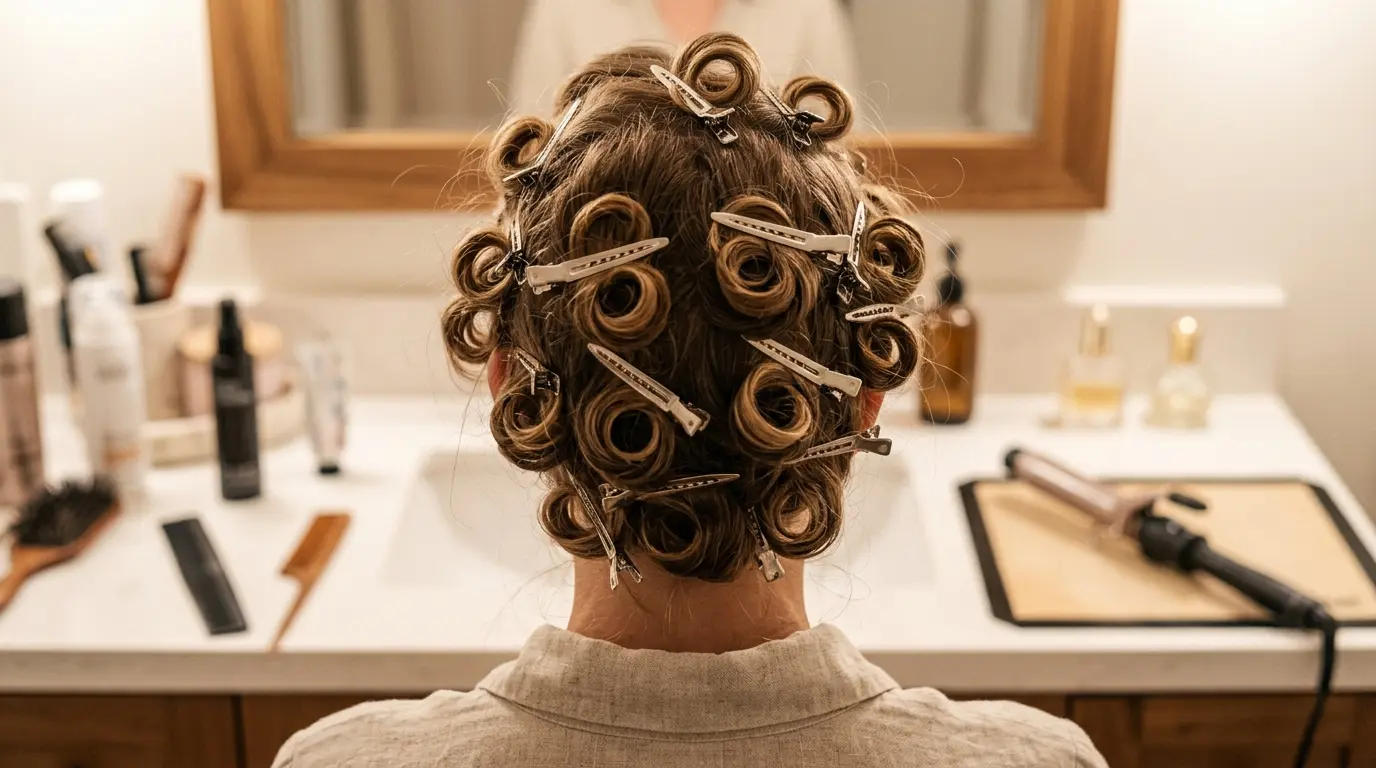
So: as you release each wave from the iron, catch it in your palm, coil it loosely against your head, and pin it with a clip.
Do this for every section. Leave all the clips in until your hair is completely cool to the touch — ten minutes is usually enough, and doing your makeup fills the time nicely.
Then release them all at once.
The difference between pinned-to-cool and dropped-hot waves is not subtle. On fine hair it is often the difference between waves that last an hour and waves that last a day.
Finishing Without Flattening
Do not brush. A brush will pull the waves out entirely. Shake your hair out with your fingers, and separate only as much as you need.
Add a little more texturizing spray after to rough the waves up and give them that undone quality. This is what makes them look beachy rather than styled.
Use a flexible hairspray, misted from a distance of about thirty centimetres. Heavy hold sprays make fine hair look stiff and, counterintuitively, flatter.
Resist touching them. Running your hands through your hair repeatedly is the fastest way to relax a wave.
Making Them Last Overnight
Fine hair waves often survive to day two with a bit of care.
Sleep with your hair in a loose bun on top of your head, secured with a soft scrunchie rather than an elastic. Use a satin or silk pillowcase to reduce friction.
In the morning, shake it out, add a little dry shampoo at the roots for lift, and touch up two or three sections rather than redoing the whole head.
If Heat Is Not Working For You
Fine hair and daily heat are a poor combination long-term, and there are heatless routes to the same look.
Damp hair braided into two or three loose braids overnight gives soft waves by morning. So do heatless curling rods, or twisting damp sections and pinning them. A texturizing spray on damp hair before braiding improves the hold considerably.
These take longer but do no damage, and on fine hair that is a meaningful trade. If you have already noticed your hair looking limp and translucent at the ends, a proper break from heat is the place to start.
Frequently Asked Questions
Why won’t my fine hair hold a curl even with a lot of hairspray?
Hairspray applied over a curl that was never properly set cannot save it. The set happens during cooling — if the wave was released hot and allowed to hang, it had already relaxed before the spray went on. Pin each section to cool first, then spray.
Is dirty hair really better for curling?
Second-day hair genuinely holds a wave better, because natural oils add grip that freshly washed hair does not have. If you need to style on wash day, a texturizing spray does much the same job.
What temperature should I use on fine hair?
The low to middle part of your tool’s range. Fine strands heat through almost instantly, so high settings add damage without adding hold. If your tool has no temperature control, it is likely too hot — this is worth solving.
Should I curl the ends or leave them out?
Leave them out. Straight, slightly loose ends are what makes a wave read as beachy rather than as a formal curl. Wrapping the ends around the barrel produces a very different, more polished look.
How do I get waves without any heat?
Braid damp hair into two or three loose braids overnight, or twist damp sections and pin them. Heatless curling rods work well too. Applying a texturizing spray to the damp hair beforehand noticeably improves how long the result lasts.