
Going darker on a human hair unit is one of the more forgiving colour jobs you can do at home. You are depositing pigment rather than stripping it, the hair is already lightened so it takes colour readily, and the result is usually predictable.
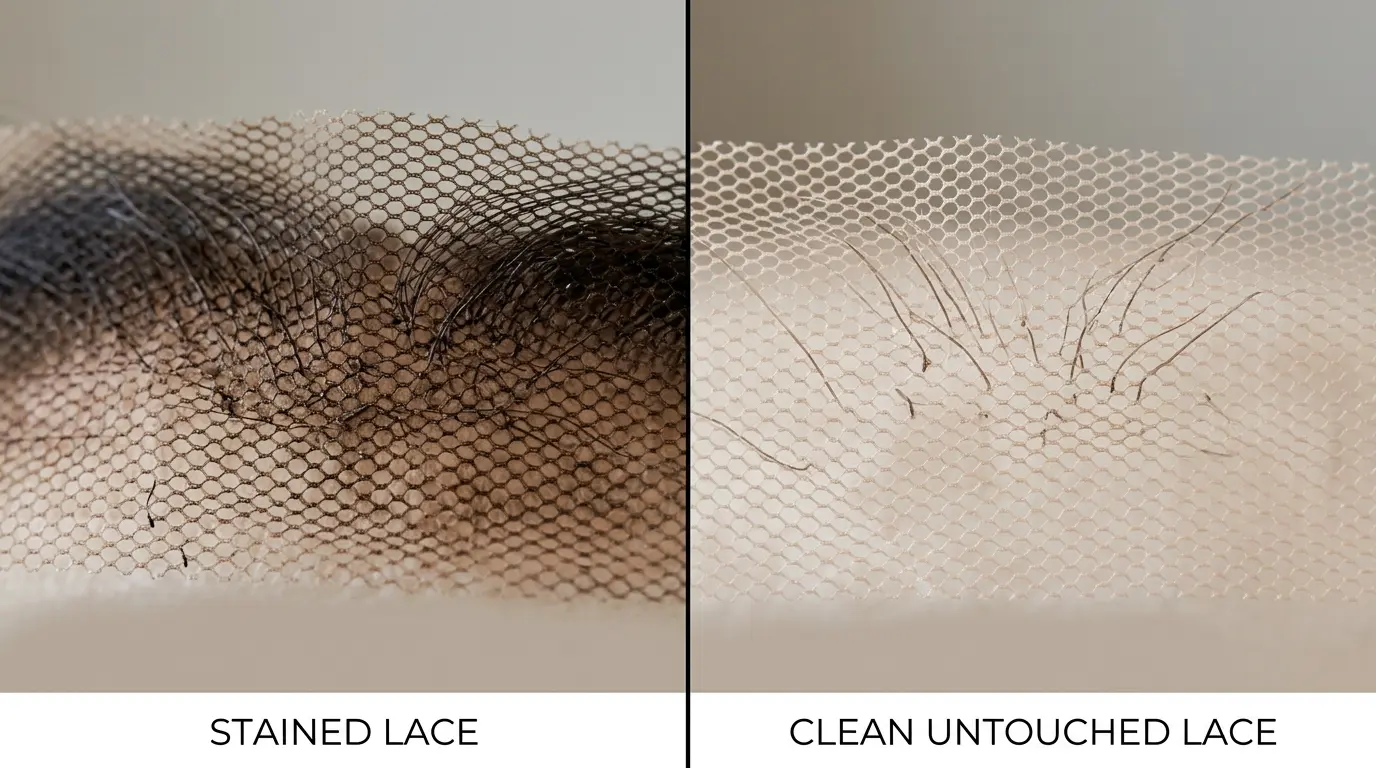
The thing that goes wrong is almost never the hair. It is the lace. Dye wicks into that fine mesh, dries several shades darker than your skin, and turns an invisible hairline into a dark shadow across your forehead — permanently. A perfect colour job on a stained lace is a ruined wig.
Here is how to keep the colour where it belongs.
Why the Lace Is So Vulnerable
Lace is a fine, porous mesh, and porous materials absorb liquid. It sits directly against the knots at the base of every strand — precisely where dye naturally pools when you apply it to the roots.
Worse, lace has no cuticle and no colour of its own to speak of. Once pigment is in there, it does not fade out the way it does from hair. Most lace staining is effectively permanent.
There is a second casualty too. The knots themselves are the weakest point of the wig, and saturating them with dye and developer can loosen them, causing shedding along the hairline. It is the same mechanism that makes any chemical over-processing of the knots risky.
So the whole technique comes down to one idea: keep the product off the first centimetre or two at the base, and give any drips somewhere to go other than the mesh.
Choose the Gentlest Colour That Will Do the Job
Going darker means depositing pigment, which does not require the lift that going lighter does. That opens up gentler options.
Semi-permanent colour deposits pigment without developer. It is the safest choice for a wig — kinder to already-processed hair, less likely to damage knots, and less aggressive if it does touch the lace. It fades over several washes, which is a genuine advantage if you are experimenting.
Demi-permanent colour uses a low-volume developer and lasts longer while still being deposit-only. A good middle ground.
Permanent colour is generally more than you need for going darker on a wig, and the developer is harder on both hair and knots.
Colour-depositing conditioners and masks are the gentlest option of all, and surprisingly effective for a subtle shift or for refreshing a colour.
Bear in mind that wig hair is usually more porous than growing hair, so it takes colour fast and often ends up darker than the shade on the box. Choosing a shade slightly lighter than your target is a sensible hedge.
Setting Up Your Barrier
This is the part that protects your investment.
Work on a mannequin head so you have both hands free and can see the hairline clearly.
Fold the lace back and clip it. Where the design allows, fold the excess lace up and away from the hair and pin it with clips or T-pins. Lace that is not near the dye cannot be stained by it.
Apply a barrier along the lace. A thin layer of petroleum jelly or a purpose-made scalp protector, applied with a cotton swab along the lace and just up to the base of the knots, gives dye nothing to soak into. Be generous along the perimeter — this is where drips travel.
Cover the lace with plastic wrap if you want a second layer of security. A strip pressed over the barrier keeps splashes off entirely.
Protect your surroundings. Old towels, gloves, and a surface you do not mind staining. Dye finds everything.
Applying Colour Without Touching the Base
The technique here is called suspended application, and it is straightforward once you see the logic.
Start about one to two centimetres away from the base. Do not apply at the roots the way you would on your own head. There is no scalp here and no regrowth to cover — the base of the hair is the last thing that needs colour.
Hold the section away from the cap. Lift a section of hair with one hand so it hangs clear of the lace, and brush the colour on with the other. Working in mid-air rather than against the cap means drips fall away from the mesh instead of into it.
Work in thin sections, clipping the rest away. Thin sections give even coverage and reduce the amount of product sitting anywhere.
Do not overload the brush. Excess product runs. A thinner, more even coat gives a better result anyway.
Do the hairline area last and most carefully, using the least product of anywhere on the wig.
Check underneath as you go. Colour that has run down to the cap is far easier to wipe away in the first few minutes than after it has processed.
Follow the processing time on the product, and check a strand early. Porous wig hair often reaches the target shade well before the stated time.

Rinsing in the Right Direction
Rinsing is where a lot of careful work gets undone.
Turn the wig so the cap is up and the hair hangs down. Water should carry the dye away from the lace, down the length, and into the sink. Rinsing with the lace facing up, or dunking the wig in a basin, floods pigment straight into the mesh.
Use cool water. Cool water closes the cuticle, holds the colour better, and is gentler on the knots.
Rinse for longer than feels necessary. Residual dye keeps depositing, and any left near the cap will find the lace eventually.
Wipe the lace immediately with a damp cotton pad while everything is still wet. If a little pigment has reached the mesh, this is your one good window to lift it.
Do not shampoo straight away unless the product instructs it. Most colours ask you to condition, not shampoo, on the first rinse.
Follow with a deep conditioner through the mid-lengths and ends. Colouring is drying, and wig hair has no oil supply to compensate.
If the Lace Does Get Stained
Act fast. While it is wet, gentle dabbing with a damp cotton pad lifts some pigment. A little clarifying shampoo worked very gently into the lace with a fingertip can lift a bit more.
Once it has dried and set, your realistic options are cosmetic rather than corrective: tint the whole lace to a colour that suits your skin so the stain blends in, tint with a foundation or powder each time you wear it, or wear the unit slightly further back so less lace shows.
Aggressive attempts to bleach the stain out will destroy the lace, which becomes a different problem entirely — see our guide to repairing torn lace.
Prevention really is the whole strategy here.
Aftercare and Keeping the Colour
- Wait a few days before washing so the colour settles
- Use sulphate-free, colour-safe shampoo thereafter
- Wash in cool water and as infrequently as the unit needs
- Keep it out of direct sunlight, which fades deposited colour quickly
- Use a heat protectant when styling, and keep temperatures moderate
- Deep condition regularly — coloured wig hair dries out faster than you expect
Expect some fading, particularly with semi-permanent colour, and expect the first couple of washes to run a little.
If colouring at home feels like too much risk for a unit you love, buying the shade you want is often the smarter call. Premium pre-dyed human hair is coloured before the lace is attached, or with proper protection in place, which removes the staining risk entirely and usually gives a more even result than home application.
Frequently Asked Questions
Can I dye a human hair wig at home safely?
Going darker is generally very doable at home, since it deposits pigment rather than lifting it. Going lighter is far riskier on a wig — the hair has usually been processed already and cannot be conditioned by a scalp, so it damages easily. Darker is the home-friendly direction.
What kind of dye is best for a human hair wig?
Semi-permanent or demi-permanent colour is usually the best choice. Both deposit without heavy lift, are gentler on the knots, and do less damage to already-processed hair than permanent colour with a high-volume developer.
Will petroleum jelly on the lace ruin the wig?
Used sparingly along the lace as a barrier, it works well and washes out with a gentle clarifying shampoo afterward. Slathering it on can leave residue that affects how adhesive or setting products grip later, so apply a thin layer with a cotton swab rather than by hand.
How do I get dye off lace after it has dried?
Realistically, you usually cannot remove it fully. Set dye in lace mesh is largely permanent. The practical solution is to tint the whole lace to match your skin so the stain blends in rather than reading as a patch.
Can I dye a synthetic wig darker?
Not with standard hair dye, which cannot penetrate synthetic fibre. Some people use fabric or alcohol-based inks made for synthetic hair, with mixed and often unpredictable results. Buying the colour you want is a far more reliable route with synthetic units.