
You skip the hair dryer to be kind to your hair, and you are rewarded with a shape that can only be described as triangular. Flat on top, enormous at the bottom, and covered in a soft halo of strands doing their own thing.
Meanwhile the same hair, blow-dried, behaves perfectly. It feels like a punishment for good behaviour.
It is not. Air drying wavy hair works extremely well once you know the rules — and nearly all the puffiness comes from a handful of habits that are easy to change.
What Puffiness Actually Is
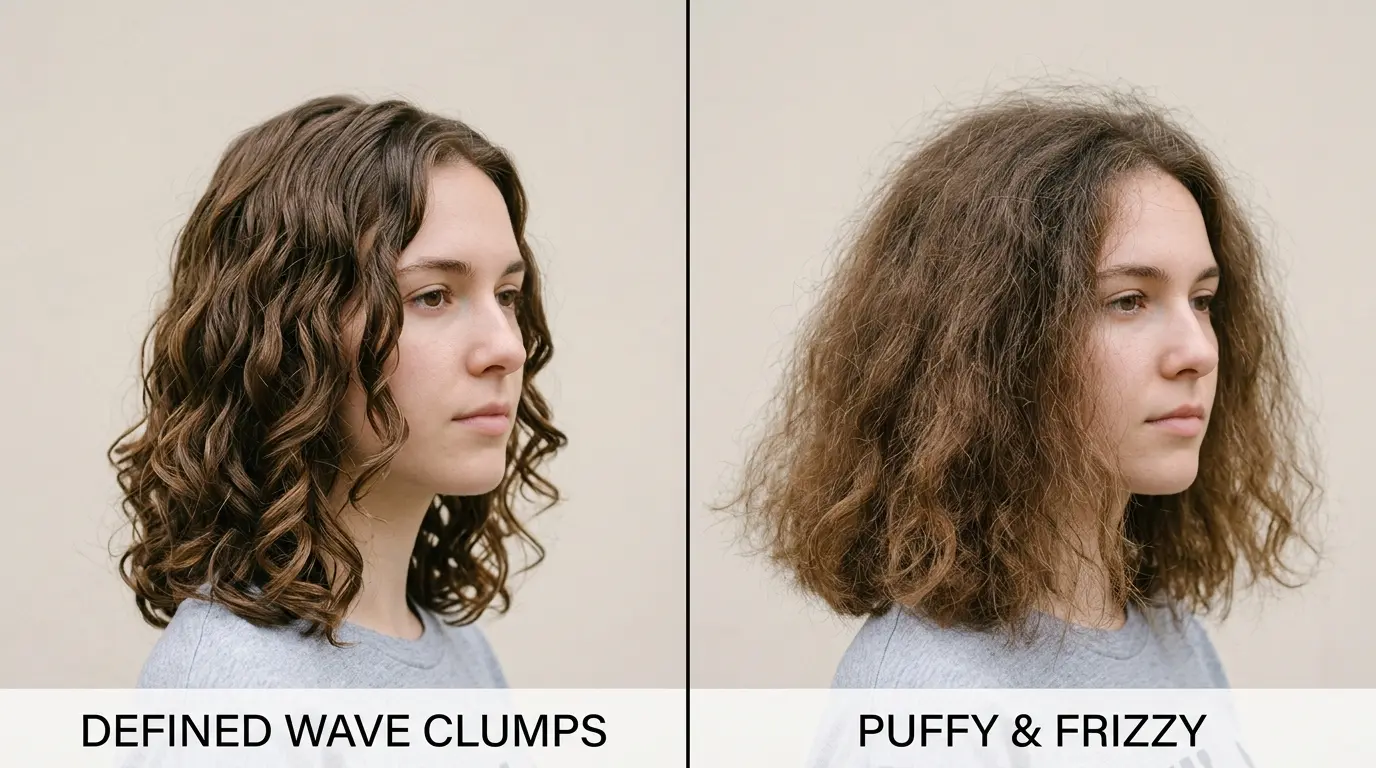
Wavy hair dries in clumps. Several strands group together, dry as a unit, and form a defined wave. That clump is what gives you shape.
Puffiness is what happens when those clumps are broken apart. Instead of a hundred defined waves, you get thousands of individual strands drying in slightly different directions — which reads as volume without shape, and as frizz.
Three things break clumps apart:
Touching wet hair. Every finger-rake, every scrunch mid-dry, every time you check whether it is dry yet separates clumps that were forming.
Terry towelling. The rough loops of a bath towel grab individual strands and pull them out of their groups, roughing up the cuticle at the same time.
Brushing when dry. The final blow. A brush through dry wavy hair separates every clump you spent hours forming.
There is also a humidity element. Frizz-prone hair is often slightly porous, meaning the cuticle is not lying completely flat. Humid air gets in, the strand swells, and the cuticle lifts further. That is why the same routine gives different results in July and January.
Start in the Shower
Your air-dry result is largely decided before you leave the bathroom.
Condition generously and rinse cool. Cool water helps the cuticle lie flat, which is the physical basis of smoothness. It does not need to be freezing — cooler than your shower temperature is enough.
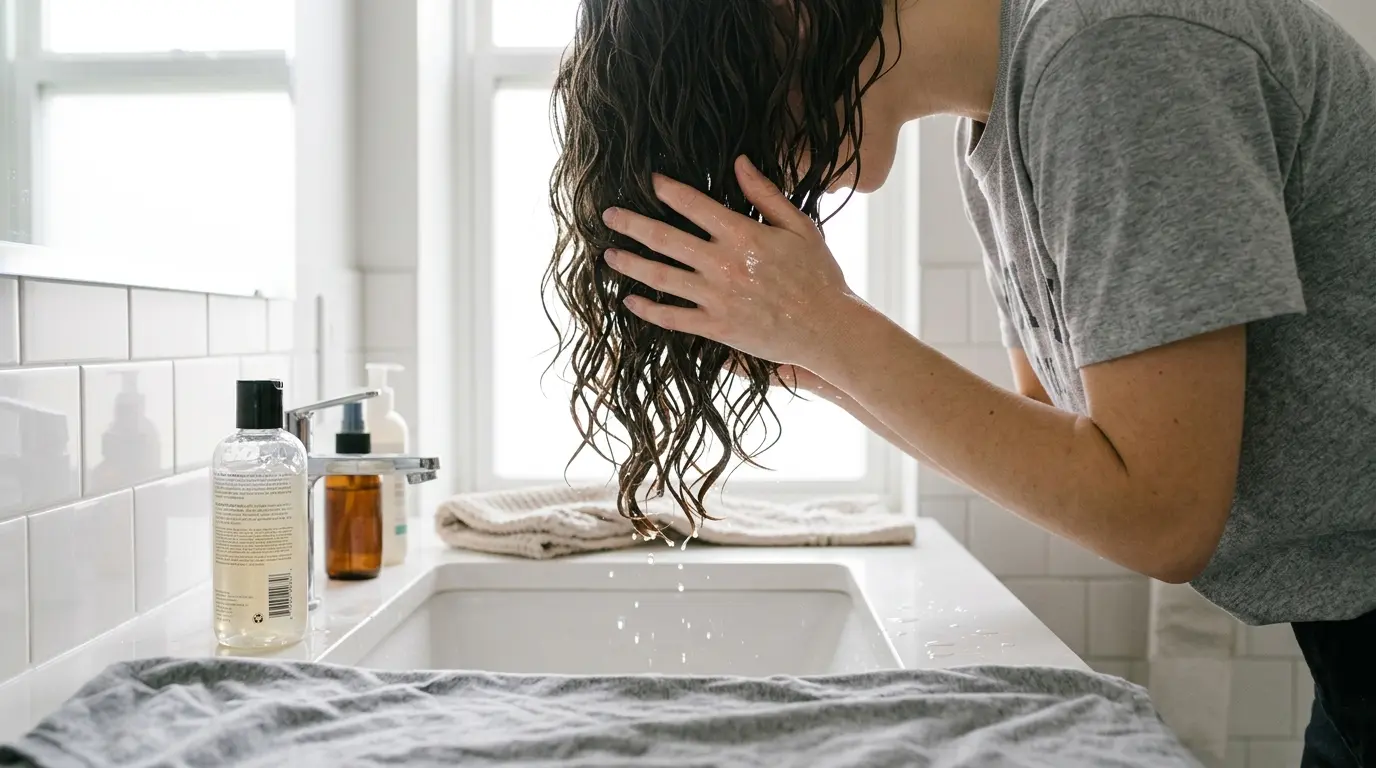
Detangle in the shower, with conditioner in. Wet hair with slip is the safest state to comb. Use a wide-tooth comb or your fingers, working from the ends up. Never detangle dry.
Squish the conditioner in before rinsing. Cup a section in your palm and push it upward toward your scalp, repeatedly. You will hear a squelching sound — that is water and product being pushed into the hair, and it is what starts the clumps forming.
Rinse lightly, or not entirely. Wavy hair often looks best when a little conditioner is left in. Experiment.
Getting Water Out Without Wrecking the Shape
Never rub with a terry towel. This is the single biggest cause of frizz in most people’s routines.
Use a microfibre towel or a cotton T-shirt instead. Both have smoother surfaces that absorb without grabbing.
Squeeze, do not rub. Cup sections and press upward. Think of blotting a stain rather than drying a dish.
Or try plopping. Lay a T-shirt flat, flip your head forward so your hair lands in the middle of it, wrap the shirt around your head and secure it. This holds the waves in a compressed, curled position while excess water drains away. Ten to twenty minutes is plenty — much longer and you risk a flat, damp-at-the-roots result.
Applying Product to Soaking Wet Hair
Timing matters enormously here, and most people get it wrong.
Apply everything while the hair is genuinely wet — dripping, not damp. Product distributes evenly through wet hair and clumps it together. On damp hair it goes on patchily and separates strands rather than grouping them.
A leave-in conditioner first, raked or squished through gently.
Then something with hold. This is the step people skip and then wonder why their waves fall flat. A curl cream, mousse, or a light gel forms a cast around the wave as it dries — a slightly crunchy shell that holds the shape while the hair inside dries undisturbed.
The crunch is not the finished look. It is scaffolding, and you remove it later.
Apply by scrunching upward, section by section, pushing hair toward your scalp.
How much depends on your hair. Fine wavy hair gets weighed down easily; thicker or coarser hair can take considerably more. If your hair goes limp and greasy-looking, use less next time. If it goes puffy, use more.
If you want somewhere to start, anti-frizz styling creams formulated for wavy hair strike a reasonable balance between moisture and hold without the heaviness of curl products designed for tighter textures.
The Hard Part: Leaving It Alone
Once the product is in, do not touch your hair again until it is one hundred percent dry.
Not to check it. Not to fluff it. Not to move a section that looks wrong. Every touch during drying separates clumps and creates frizz, and the frizz appears in exactly the spot you touched.
This is genuinely the hardest part of the routine and the one that makes the biggest difference.
A few things that help:
Dry with your hair off your shoulders where possible — pinned loosely on top of your head or hanging clear — so it is not being flattened and rubbed by your clothes.
Do not sleep on it wet. Hair dries into whatever shape the pillow puts it in, and that shape is a flat, creased one on one side.
Give it time. Wavy hair can take one to three hours to dry fully depending on length and density. Plan around it — wash in the evening, or on a day you are not going out immediately.
Root clips placed at the crown while drying lift the roots and address the flat-on-top part of the triangle problem.
Scrunching Out the Crunch
When your hair is completely, entirely dry — and only then — take a small amount of oil or serum on your palms, or just use dry hands, and gently scrunch upward through the lengths.
The cast breaks, the crunch disappears, and what is left underneath is a soft, defined wave that has been protected from frizz the whole time it was drying.
If you scrunch while there is any dampness left, the wave will relax and frizz. Wait.
Managing Frizz Between Washes
- Sleep on satin or silk, or in a loose pineapple on top of your head. Cotton pillowcases create friction all night.
- Refresh rather than rewash. A spray bottle with water and a little leave-in, scrunched in, revives waves in two minutes.
- Do not brush. Fingers only, and ideally not at all.
- Adjust for humidity. Damp weather generally calls for more hold; dry weather calls for more moisture.
- Consider your washing frequency. Over-washing strips wavy hair and makes it frizzier.
If your frizz is persistent despite a good routine, product buildup may be dulling and weighing things down — our guide on clearing buildup covers how to reset without stripping colour.
Frequently Asked Questions
Why does my hair look good wet and puffy when it dries?
Because the clumps that are visible when your hair is wet get broken apart during drying — usually by towel rubbing, by touching it, or by not using a product with enough hold to keep the clumps together as they dry.
How long should I leave a T-shirt plop in?
Ten to twenty minutes is usually right. Long enough to absorb excess water, short enough that the waves are not squashed flat or left damp at the roots.
Is the crunchy cast supposed to stay?
No. The cast is temporary scaffolding that protects the wave shape while the hair dries. Once the hair is completely dry, scrunch it out with your hands and the crunch disappears, leaving soft defined waves behind.
Can I air dry without any product?
You can, but frizz-prone wavy hair usually needs something to hold clumps together. Without hold, the clumps separate as they dry and you get volume without definition. Even a small amount of light mousse makes a noticeable difference.
Why is my hair flat on top and puffy at the bottom?
Root volume gets crushed by the weight of wet hair and by drying with hair against your shoulders, while the ends expand as they dry. Root clips at the crown and keeping hair off your shoulders while it dries both help balance the shape.