
You spent ten minutes swooping them into place. They looked perfect. You put your coat on, glanced in a shop window, and there they are — standing straight up like they never met a brush.
Baby hairs on a wig behave differently from the ones growing out of your own head, and once you understand why, the whole problem becomes solvable. It is not that you are using the wrong product. It is usually that you are asking the hair to do something it has not been prepared to do.
Why Wig Baby Hairs Fight You
They have no root direction. Your own baby hairs grow out of follicles angled a particular way, so they naturally lie in a direction. A knot on lace has no angle. The hair comes straight out of the mesh and points wherever it wants.
They have fibre memory. Synthetic strands and processed human hair both hold the shape they were last set into. If the hair has spent months packed in a box pointing upward, that is the shape it will keep returning to.
They are usually too long. Real baby hairs are short — often only a couple of centimetres. Wig hair at the hairline is frequently full length, and a long hair simply has more leverage to spring up. This is the most common cause and the most overlooked.
They are often too thick. Factory hairlines are dense, and a thick clump of hair resists lying flat in a way that a few fine strands does not.
There is no scalp oil. Your own baby hairs get a little natural weight from sebum. Wig hair gets nothing.
So the fix is not just more product. It is shortening them, removing the memory, and setting them properly.
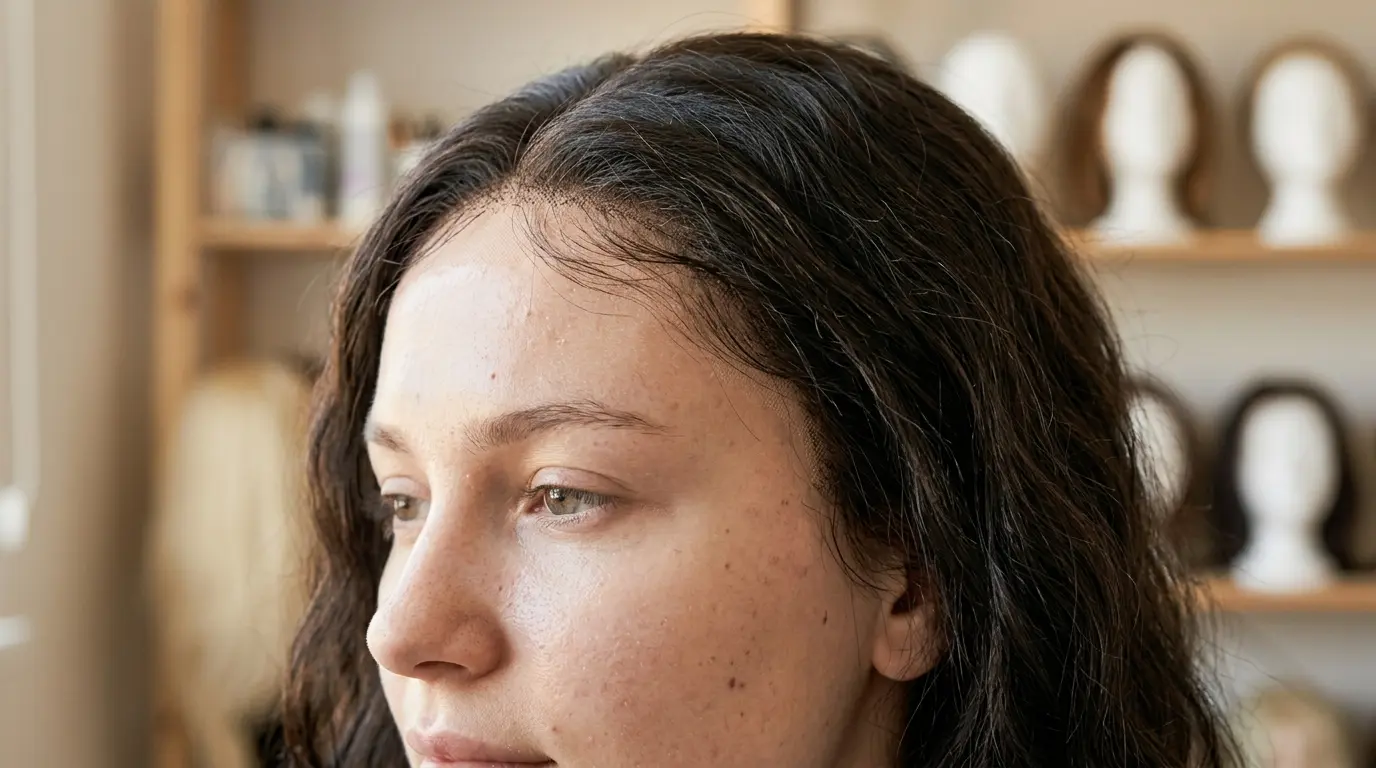
Trim Them First
This is the step that fixes most stubborn baby hair problems, and almost nobody does it.
Pull out a small amount of hair from the very front of the hairline — genuinely small, a fine wispy amount rather than a thick section. Then trim it short. Two to four centimetres is a reasonable range, though it depends on your face and the look you want.
Short hairs lie flat because there is very little length to spring back. Long hairs fight you all day no matter what you put on them.
Cut at an angle rather than straight across, and vary the lengths slightly. Uniform baby hairs of identical length look artificial, and irregularity is what sells the whole thing.
If the hairline is too dense to work with in the first place, thinning it is a separate job worth doing properly — our hairline plucking guide walks through it.
Remove the Memory
Hair that keeps returning to the same upward position has been set that way. You can reset it.
For synthetic fibre: a garment steamer held at a distance while you comb the baby hairs downward will soften the fibre enough to reshape. Let it cool completely in the new position before touching it — the cooling is what sets it. Same principle as our steam restoration method.
For human hair: a flat iron on a low setting, used briefly to press the baby hairs downward in the direction you want them, works well. Use a heat protectant and keep the iron well away from the lace, which is damaged easily by direct heat.
For heat-friendly synthetic: the same, but check the label first and test on a hidden strand.
Once the memory is reset, they will cooperate far more readily every time you style them.
Applying Product Properly
Use a small amount. Overloading is the number one styling mistake. Too much product does not hold better — it flakes, goes white as it dries, builds up on the lace, and looks obviously pasted on.
Choose the right consistency. A firm gel or pomade-style edge control gives stronger hold; a lighter mousse gives a softer, more natural result. Wig hair generally needs more hold than growing hair does, so strong hold edge controls formulated for units are usually a better fit than a light everyday product.
Apply in thin layers. Take a tiny amount on a soft toothbrush or an edge brush, and work it through the baby hairs in the direction you want them to lie. Add a second thin layer only if the first is not holding.
Brush from underneath. Coming at the hairs from below and pressing down is more effective than dragging a brush across the top.
Shape them naturally. Restraint matters here. Real baby hairs are wispy, slightly uneven and mostly follow the direction the hair grows. Dramatic symmetrical swoops read as decorative rather than natural — which is a valid style choice, but a different one from making the wig look like your hair.
Do not get product on the lace itself any more than you have to. It builds up, discolours the mesh, and interferes with how the lace sits.
The Band Method That Locks It In
Here is what turns a five-minute style into an all-day one.
Once the product is applied and the baby hairs are shaped, wrap an elastic melting band or a wide fabric headband around your head, directly over the hairline. Press it firmly enough to hold the hairs flat against your skin.
Leave it for fifteen to twenty minutes while the product dries. You can speed this up with a hair dryer on cool, moving constantly, but doing your makeup in the meantime is easier.
Remove the band by rolling it upward and off rather than pulling it forward, which drags everything with it.
This is the same technique used for setting the whole lace edge, so doing both at once saves time.

Making Them Last Through the Day
- Set with a light mist of hairspray once the edge control has dried, held about thirty centimetres away.
- Do not touch them. Every touch transfers oil and lifts the hairs.
- Keep your hairline clean before styling. Oil and moisturizer on the skin underneath stop product gripping. Wipe with witch hazel and let it dry fully.
- Carry a small edge brush for touch-ups. Ninety percent of the time you only need to re-press one section, not restyle everything.
- Expect humidity to shorten the hold. Damp weather calls for a firmer product.
Cleaning Product Off Afterward
Edge control builds up on lace surprisingly fast, and built-up lace looks cloudy and grips badly.
Wipe the lace with a damp cloth after each wear. When you wash the unit, work a small amount of gentle shampoo into the lace with your fingertips to lift residue, and rinse thoroughly.
If the product has gone hard and crusty, let a damp cloth sit on it for a minute to soften it rather than scrubbing — scrubbing tears lace, which turns into a repair job.
When Baby Hairs Are Not the Answer
Worth saying plainly: not every hairline needs them. A softly plucked, well-melted hairline with no baby hairs at all can look completely natural, and heavy-handed baby hairs can actually make a wig more obvious rather than less.
If yours keep fighting you, or the style you are attempting is not suiting your face, leaving them out is a perfectly good option.
Frequently Asked Questions
Why do my wig baby hairs keep standing up?
Usually because they are too long, or because the fibre has memory set from being packed upward. Trimming them shorter and resetting the direction with steam or a low-heat iron solves most cases. Product alone rarely fixes a hair that is fighting its own memory.
Can I use regular gel instead of edge control?
You can, but most gels are formulated for the friction and weight of growing hair. Wig baby hairs have no root anchoring them and often need a firmer hold, so a dedicated edge control tends to work better and flake less.
How short should wig baby hairs be?
Roughly two to four centimetres, cut at an angle and with slightly varied lengths. Real baby hairs are short and wispy, so anything much longer both looks less natural and springs up more easily.
How do I stop edge control from turning white?
White residue almost always means too much product, or a second layer applied over one that had not dried. Use a small amount, apply in thin layers, and let each layer dry before deciding whether it needs more.
Will laying baby hairs damage the lace?
Not if you are gentle. The risks come from scrubbing at dried product, brushing aggressively across the mesh, and letting product build up over weeks. Wipe the lace after wear and clean it properly at wash time.