
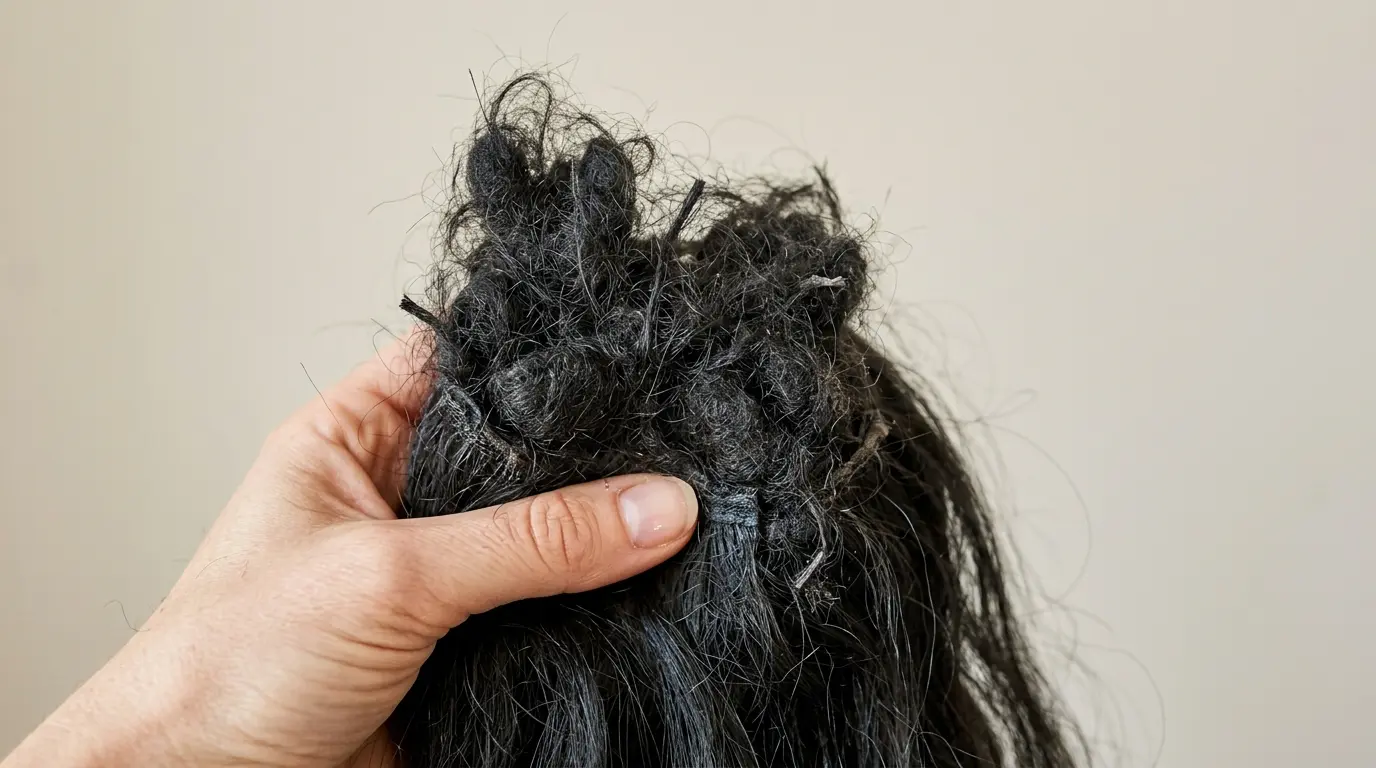
You pull the unit out of the drawer, and the underside at the nape has fused into something closer to felt than hair. Running a comb through it moves the whole mass rather than separating anything, and every attempt sheds another small handful.
Before you bin it: this is one of the most rescuable problems in wig care. Fabric softener has been the go-to fix for decades, and the reason it works is not folklore — it is straightforward chemistry.
Why Synthetic Fibre Mats in the First Place
Your own hair produces oil that coats each strand and keeps things sliding past one another. Synthetic fibre produces nothing. Once its factory coating wears off, the strands are essentially bare plastic rubbing directly against bare plastic.
Two things follow. First, friction roughs up the surface of the fibre, and roughened strands catch on each other like tiny hooks. This damage is concentrated wherever the wig rubs against something all day — the nape, under a coat collar, along a seatbelt line. That is why matting almost always starts in the same places.
Second, plastic builds static readily. Static makes strands cling and repel unpredictably, which is why a wig can look frizzy and knotted the moment you take it off on a dry winter day.
Fabric softener addresses both. It contains cationic conditioning agents that deposit a thin, slippery, positively charged film on the fibre. That film reduces friction so strands slide instead of catching, and it neutralizes static so they stop clinging.
One honest limit up front: softener manages damage; it does not undo it. Fibre that has been rubbed rough stays rough. If a section has genuinely fused from heat exposure, no soak will bring it back.
What You Will Need
- A clean sink, basin or bath
- Liquid fabric softener
- A wide-tooth comb, ideally with steel teeth, plus a wig brush with looped bristles
- A spray bottle
- A mannequin head or wig stand
- A towel
- Time. Genuinely — set aside an hour and do not rush the comb-out
Mixing and Soaking
Two useful ratios, depending on how bad things are.
For a full soak: fill your basin with cool or lukewarm water — never hot, unless the packaging specifically says the fibre is heat-friendly — and add roughly one to two tablespoons of softener per basin. Swish to disperse it before the wig goes in.
For a spray: mix about one part softener to four or five parts water in a spray bottle. This is the better option for a wig that is only tangled in patches, or when you want to work on a section at a time.
Submerge the wig and let it sit for twenty to thirty minutes. Do not agitate it, do not scrub, and above all do not wring or twist. Mechanical force is what created the problem, and synthetic fibre has no capacity to repair itself.
For severe matting, half an hour is fine but longer is not better — an all-night soak leaves a heavy, greasy residue that attracts dirt and dulls the hair.
Combing Out From the Bottom Up
This is where patience pays off, and where most people go wrong.
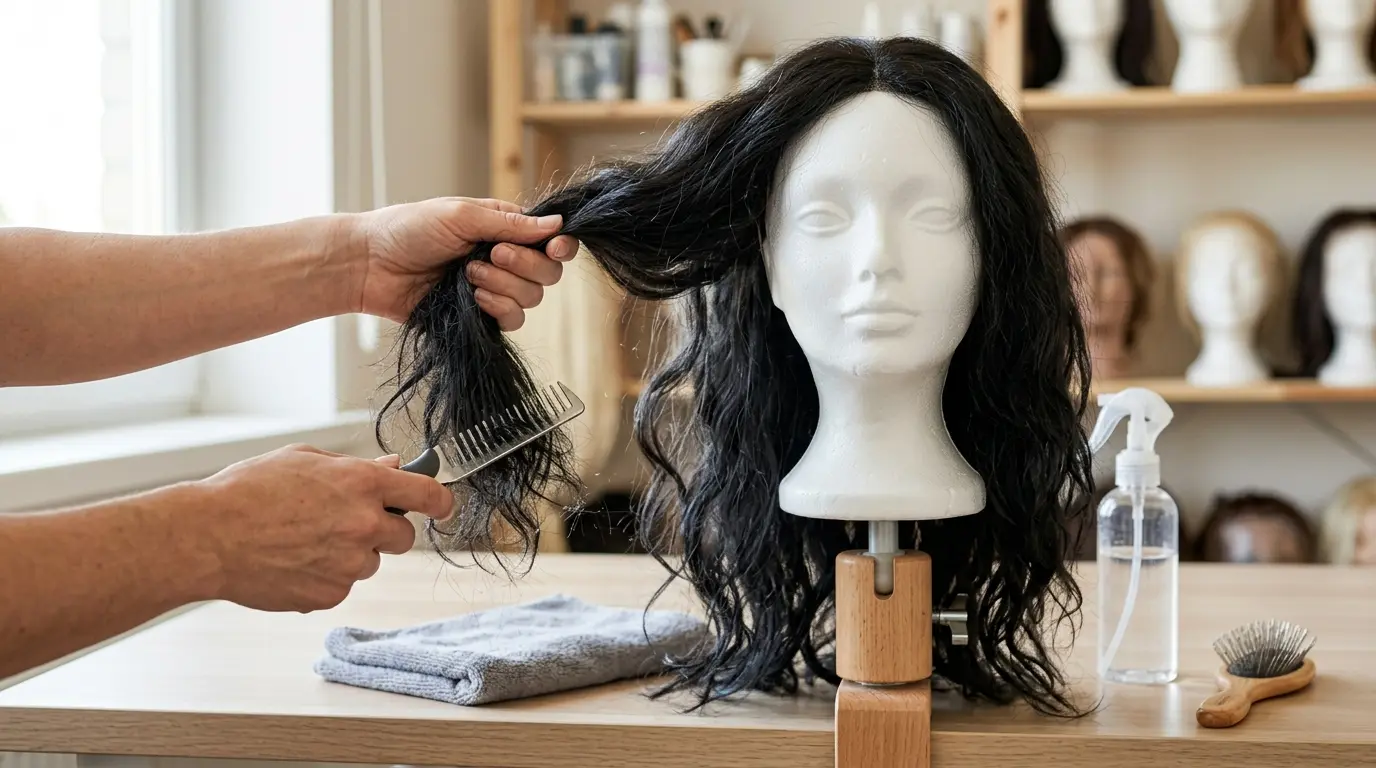
Lay the wig flat or fit it to a stand so you can work with both hands and see the whole section.
Start at the very ends. Not the roots, not the middle. Take a small section — smaller than you think, no wider than a few centimetres — and comb only the last few centimetres of it until the comb passes through cleanly.
Move up in small increments. Once the ends are clear, start a couple of centimetres higher and comb down through the section you already freed. Repeat, moving upward a little at a time, until you reach the cap.
The logic is simple: combing from the top pushes every knot down into a bigger knot at the ends. Combing from the bottom removes them one at a time.
Hold above where you are combing. Grip the section with your other hand between the comb and the cap. This takes tension off the knots so they release rather than tearing out.
Use your fingers on the worst spots. For dense felted areas, pull the mass apart gently with your fingertips before any comb goes near it. Mist with your softener spray as you go if things stiffen up.
Expect some shedding. A modest amount is normal and unavoidable. Handfuls mean you are pulling too hard — stop, re-mist, and go smaller.
Rinsing and Drying
Rinse under cool running water until the water runs clear and the fibre no longer feels slick. Leftover softener attracts dust and makes the wig look greasy within a couple of wears.
Press the water out with a towel — press, do not rub. Then fit the wig to a stand and let it air dry completely, away from radiators and direct sunlight.
Do not comb it again while it is wet, and do not use a hair dryer unless the fibre is specifically rated for heat. Wet synthetic fibre is at its most vulnerable, and this is exactly when people undo an hour of careful work.
Once dry, a final gentle pass with a looped-bristle wig brush settles everything into place.
Keeping It From Happening Again
Matting is a friction problem, so the prevention is all about reducing friction.
Brush after every wear, before the wig goes into storage. Two minutes now saves an hour later.
Store it properly. On a stand or laid flat in a satin bag — never crumpled in a drawer where the fibre presses against itself. If you take units away with you, our travel storage guide covers keeping the style intact in a suitcase.
Watch the friction points. Coat collars, backpack straps, seatbelts and hair rubbing on your shoulders all wear the same spot repeatedly. Wearing longer styles pulled forward, or switching to a shorter unit for commuting, makes a real difference.
Use a softener spray as a leave-in. A light mist through the mid-lengths and ends before wear keeps static down all day. Keep it off the cap and away from the lace.
Wash on a schedule, roughly every six to eight wears. Fibre that has gone dry and dull tangles far faster than fibre that is clean and conditioned.
If your ends have gone past tangled into visibly frizzy and rough, softener will only take you so far — the fix there is steam and low-heat restoration, which works on the fibre texture itself.
And if you have rescued the same wig three times this year, it may be worth looking at what you are buying. Cheaper fibre is thicker, glossier and mats considerably faster, whereas tangle-resistant synthetics use finer, lower-friction filaments built for everyday wear. There is also a pleasant side effect: the same finer fibre tends to look far less plastic, which we cover in our guide to reducing synthetic shine.
Frequently Asked Questions
Will fabric softener damage my synthetic wig?
Used diluted and rinsed out properly, it is fine and has been standard practice for years. Problems come from using it undiluted, leaving it in without rinsing, or soaking for many hours — all of which leave a heavy residue that dulls the fibre and attracts dirt.
Can I use conditioner instead of fabric softener?
Regular hair conditioner is formulated for the cuticle of human hair, which synthetic fibre does not have, so it tends to sit on the surface and do less. Wig-specific conditioners are made for the job and are the better choice if you have one. Fabric softener remains popular because it is cheap, effective and already in most homes.
Is a matted wig ever beyond saving?
Sometimes. If a section has fused or melted from heat, or the fibre has been rubbed so rough that it re-tangles within a day of combing, you have reached the end of that unit’s life. Very heavily matted nape sections are occasionally worth trimming out rather than saving.
How often can I do a softener soak?
Occasionally as needed rather than as a routine — every couple of months at most for a wig in regular rotation. Frequent soaking builds up residue. A diluted leave-in spray between washes is a gentler way to keep things smooth day to day.