
You opened the package, slid the unit on, and in your bedroom mirror it looked incredible. Then you stepped into the bathroom light — or worse, someone took a photo with the flash on — and suddenly it had that unmistakable glow. Not healthy-hair glow. Doll-hair glow.
You are not imagining it, and you did not buy a bad wig. That shine is a predictable result of how synthetic fibre is manufactured, which is very good news: something predictable is something you can fix. In an afternoon, with things you probably already own, you can take a unit from “costume” to “she just has really nice hair.”
Why Synthetic Fibre Catches the Light So Differently
Synthetic hair is usually made from modacrylic or similar plastics, and it is produced by pushing molten polymer through a fine nozzle. That process creates strands that are almost perfectly smooth, almost perfectly round, and almost perfectly identical to one another.
Real hair is none of those things. A human strand is covered in overlapping cuticle scales, varies in thickness along its length, and grows in slightly different diameters and shades across your head. All that irregularity scatters light in dozens of directions, which our eyes read as soft, natural sheen.
A smooth, uniform fibre does the opposite. It bounces light back in one concentrated direction — the same way a vinyl raincoat looks glossy while a cotton shirt does not. Add hundreds of thousands of these strands lying in the same direction, and you get that sheet-of-light effect.
There is usually a second culprit on a brand-new unit: a factory finish. Most wigs are coated with a light silicone-based treatment so they survive shipping without matting. It does its job, but it also acts like a layer of gloss. On many wigs, simply removing this coating solves half the problem before you touch a single powder.
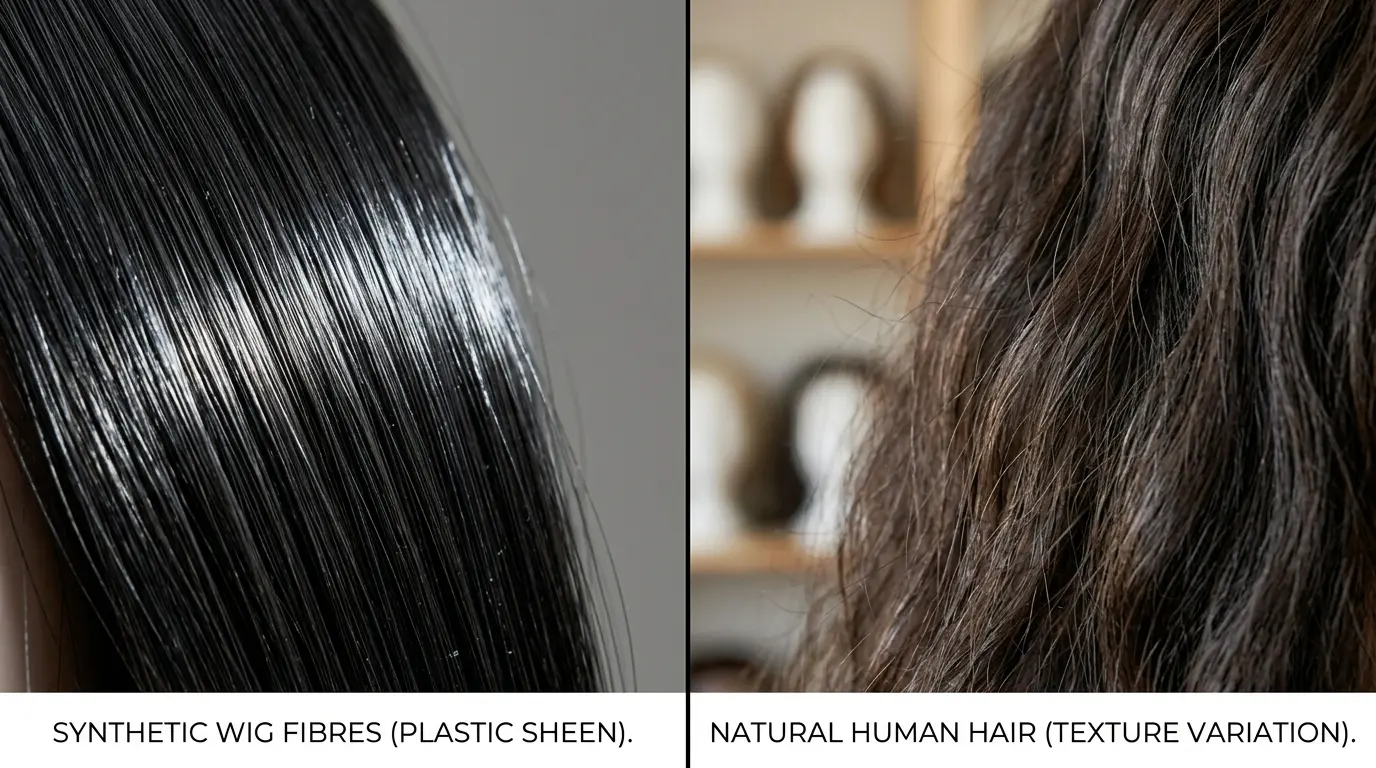
Colour plays a role too. Jet black and pale platinum show gloss most dramatically because there is such strong contrast between the lit and unlit parts of the strand. Warm mid-browns, ash tones, and colours with a darker root already read as more believable.
Strip the Factory Coating Before Anything Else
Before you reach for powder, give a new unit a gentle wash. You will be amazed how much of the glare rinses away with the coating.
Fill a clean sink or basin with cool to lukewarm water — never hot, unless the packaging specifically says the fibre is heat-friendly. Add a small amount of wig shampoo or a mild sulphate-free shampoo, swish the unit gently, and let it soak for about five minutes. Do not scrub, twist, or wring; synthetic fibre has no ability to repair itself, so mechanical damage is permanent.
Rinse in clean cool water, then do a softening rinse. A capful of fabric softener diluted in a basin of cool water is the classic approach and it does double duty, cutting residual coating while reducing static. If you would rather skip fabric softener, a tablespoon of apple cider vinegar in a basin of water works as a gentler alternative. Rinse once more, press the water out with a towel, and let the wig air-dry on a stand.
If your unit is already knotted or stiff from wear, deal with that first — a matted wig will not sit right no matter how matte you get it. Our full walkthrough on rescuing a tangled unit with a softener soak covers the soak ratios and comb technique in detail.
The Fast Matte Fix: Powder and Dry Shampoo
This is the workhorse method, and it takes about ten minutes.
Put the wig on a stand or mannequin head so you can see what you are doing and work with both hands. Brush it out completely with a wig brush or wide-tooth comb, starting at the ends and working up.
Using dry shampoo: shake the can well, then spray in light passes from about 25 to 30 centimetres away. Distance matters enormously here — close-range spraying leaves white patches and a stiff, chalky feel. Focus on the crown, the part, and the mid-lengths, which catch the most light. Let it sit for a minute or two, then brush through thoroughly.
Using loose powder: the shade is the whole game. On light blonde and grey units, a translucent or white setting powder works beautifully. On dark units, white powder will leave a dusty grey cast that looks worse than the shine did. Reach for a matte dark bronzer, a dark brown eyeshadow, or even unsweetened cocoa powder instead. Tap a little onto a clean, fluffy makeup brush, tap most of it off, and sweep downward along the hair shaft. Concentrate on the part and the surface layers.
Then shake the wig out and brush again. Restraint is everything — you are aiming to take the edge off, not to coat the hair. Overdoing it leaves a dull, dusty look, attracts lint, and can transfer onto dark clothing.
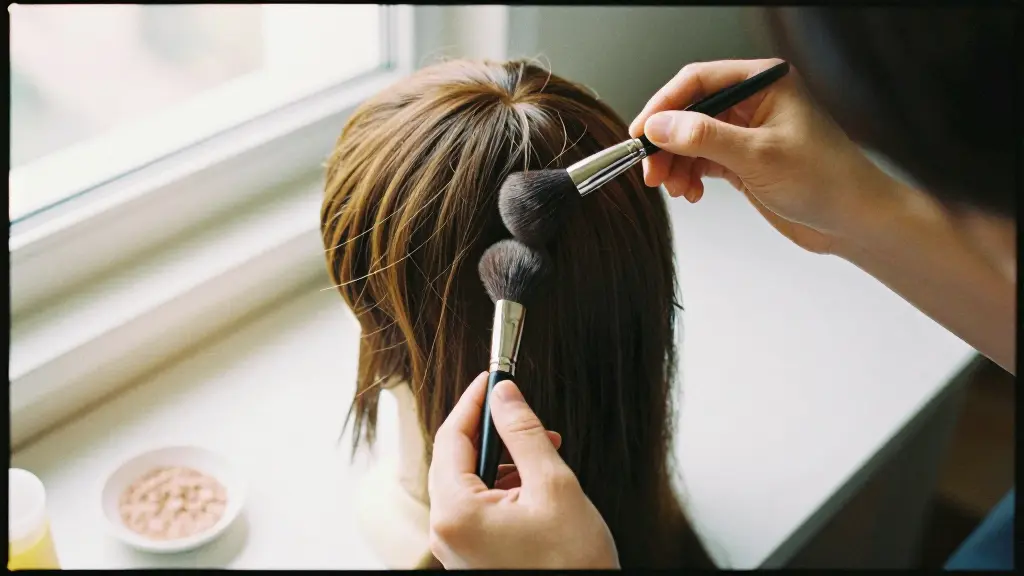
A quick word of caution: always test on the underside of the wig near the nape first, where nobody will see it if the colour goes wrong. And know that this is a surface treatment — it washes out and needs redoing.
Matte Sprays and What to Avoid
Purpose-made shine-reducing sprays for wigs exist and are worth a look if you wear synthetic units daily. A dry texture spray is another good option because it dulls the surface and adds a bit of grip and volume at the same time.
Just as important is what you keep away from the wig. Shine serums, gloss drops, silicone smoothing creams, and heavy oils will undo everything you just did. They are designed to make human hair reflective, and on synthetic fibre they turn the volume up to eleven.
Small Touches That Sell the Whole Illusion
Shine is the biggest tell, but it is rarely the only one. A few extras make a disproportionate difference:
- Shadow the roots. A light dusting of dark powder along the part and the first couple of centimetres of the roots mimics natural regrowth and instantly softens a flat, uniform colour.
- Break up the perimeter. Factory ends are cut blunt and identical. A few careful point-cuts with sharp shears — snipping upward into the ends rather than straight across — makes the outline look grown rather than manufactured.
- Soften the hairline. A too-perfect, too-dense hairline reads as artificial even on a beautiful lace unit. Our step-by-step hairline plucking guide explains how to thin it gradually without going too far.
- Add a little movement. Perfectly straight, perfectly aligned hair is a giveaway. Even a loose bend through the lengths helps light scatter instead of reflecting in one sheet.
Keeping That Matte Finish Long Term
Store the unit on a stand or in a satin bag, out of direct sunlight — UV exposure gradually degrades synthetic fibre and can shift the colour. If you’re on the move, the same principle applies; there are practical folding solutions in our guide to protecting your styles in a suitcase.
Wash sparingly. Synthetic hair does not get oily the way your scalp does, so unless you have been sweating heavily or using a lot of product, every six to eight wears is plenty. Use cool water and wig-appropriate products every time.
Watch friction points. Coat collars, seatbelts, and backpack straps rub the same section repeatedly and rough the fibre up. That damage shows as frizz rather than shine, and once the ends go, powder will not save them — the fix there is steam and low-heat restoration.
Finally, be realistic about the fibre grade you are starting with. Budget units are made from thicker, glossier filaments and there is a ceiling on how matte you can get them. If you wear synthetic every day and you are tired of fighting the same battle, it may be worth the upgrade to premium matte synthetic options, which use finer, lower-lustre fibre designed from the start to read like real hair.
Frequently Asked Questions
Does baby powder ruin a synthetic wig?
Not permanently, but it is not the best tool. Talc-based baby powder is stark white, so on any medium or dark colour it leaves an obvious grey cast, and its heavy texture can build up at the roots. A matte bronzer or dark eyeshadow gives you far more control over the finished tone.
Can I use dry shampoo on a synthetic wig?
Yes, and it is one of the most effective quick fixes. The keys are spraying from a good distance, using light passes rather than one heavy blast, and brushing it through afterward. Some buildup over time is normal, which is one more reason to include the occasional gentle wash in your routine.
Will fabric softener actually make my wig less shiny?
It helps, but indirectly. A diluted softener rinse mostly removes the glossy factory coating and calms static and roughness. It softens the overall look rather than truly mattifying the fibre, so most people combine it with a powder or matte spray for the full effect.
How do I dull a black synthetic wig without turning it grey?
Skip anything white. Use a matte dark brown or deep bronzer powder applied with a barely-loaded brush, or a purpose-made shine-reducing spray. Build in thin layers and shake the wig out between passes so you can see the true result before adding more.
How often will I need to redo this?
Powder and dry shampoo typically last until your next wash or a few days of wear, whichever comes first — think of it as makeup for your wig. Removing the factory coating, though, is a one-time job, and lower-lustre fibre stays matte on its own.